01Clinical Prognostic Stage
Determined before starting treatment based on medical history, physical exams, imaging, and biopsy results.

"Earlier the stage, the more likely the cancer can be treated successfully with less extensive measures."
When someone is diagnosed with breast cancer, doctors do tests to see how far the cancer has spread. This process is called staging. They check the size of the tumor, if it’s in nearby lymph nodes, and if it’s spread to other parts of the body. This helps them plan the right treatment.
For breast cancer, staging is based on things like the size of the tumor, if it’s spread to lymph nodes, how aggressive it is, and certain biomarkers. They use a system called TNM, tumor grade, and biomarkers to figure out the stage.
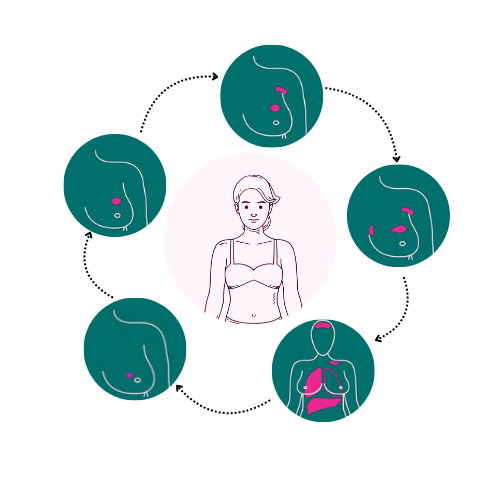
Staging groups in breast cancer help doctors understand how advanced the cancer is and how serious it might be. These groups are important because they guide doctors in choosing the right treatment and predicting what might happen to the person with cancer. By organizing the cancer into these groups, doctors can personalize treatments for each person, giving them the best chance of beating the cancer and providing them with information about their prognosis and potential risks.
Determined before starting treatment based on medical history, physical exams, imaging, and biopsy results.
Determined after surgery by examining surgical tissue and lymph nodes under a microscope for precise characteristics.
Global Standardization System
Measures the size of the primary tumor within the tissue.
Determines spread to regional lymphatic structures.
Indicates migration to distant physiological systems.
"Anatomic Stage focuses on size and spread. M0 means no spread; M1 indicates metastatic breast cancer."
Biomarkers check for signals that help cells grow, directly influencing treatment.
Evaluation of cell abnormality compared to normal cells to assess aggressiveness.
ER positive (ER+) if signal is present; negative (ER-) if not.
PR positive (PR+) if signal is present; negative (PR-) if not.
HER2+ cancers have many signals and grow faster.
These classifications depend on the presence or lack of all three signals, defining the most precise care map for your unique biology.
In breast cancer, the number staging system tells us how big the cancer is and whether it has spread. This helps doctors choose the best treatment. Early stages mean the cancer is small and hasn't spread much, while later stages mean it's bigger and may have spread further. Knowing the stage also helps predict how the treatment will go and what to expect in the future.
Powered by BioDigital Human
Additional tests and procedures are often employed during the staging process to gather more information about the extent and characteristics of the cancer.
These may include imaging tests like MRI or PET scans, as well as procedures such as bone scans or biopsies of nearby lymph nodes.
These tests help doctors gain a comprehensive understanding of the cancer's spread and guide them in determining the most effective treatment approach for the individual patient.
A procedure to test if cancer has spread beyond the original tumor. It’s most commonly used in people with breast cancer and melanoma. During the procedure, healthcare providers remove small organs called sentinel nodes and test them for cancer cells.
Doctors can check your blood for certain substances or markers that may indicate cancer or how well your body is handling treatment.
A detailed picture of the inside of your body, helping doctors see if there’s anything unusual, like a tumor.
It shows areas in your body where cells are using a lot of energy, which can indicate cancer. It helps doctors find out if cancer has spread to other parts of your body.
It’s a test to see if cancer has spread to your bones. You get a special injection, and then they take pictures of your bones to see if there are any areas that look different.
It uses sound waves to create images of your body’s organs. It’s often used to look at the breast or nearby lymph nodes to see if there are any abnormalities.
Selected clinical sources used to support this staging overview.